When was Snapchat created?
The short answer
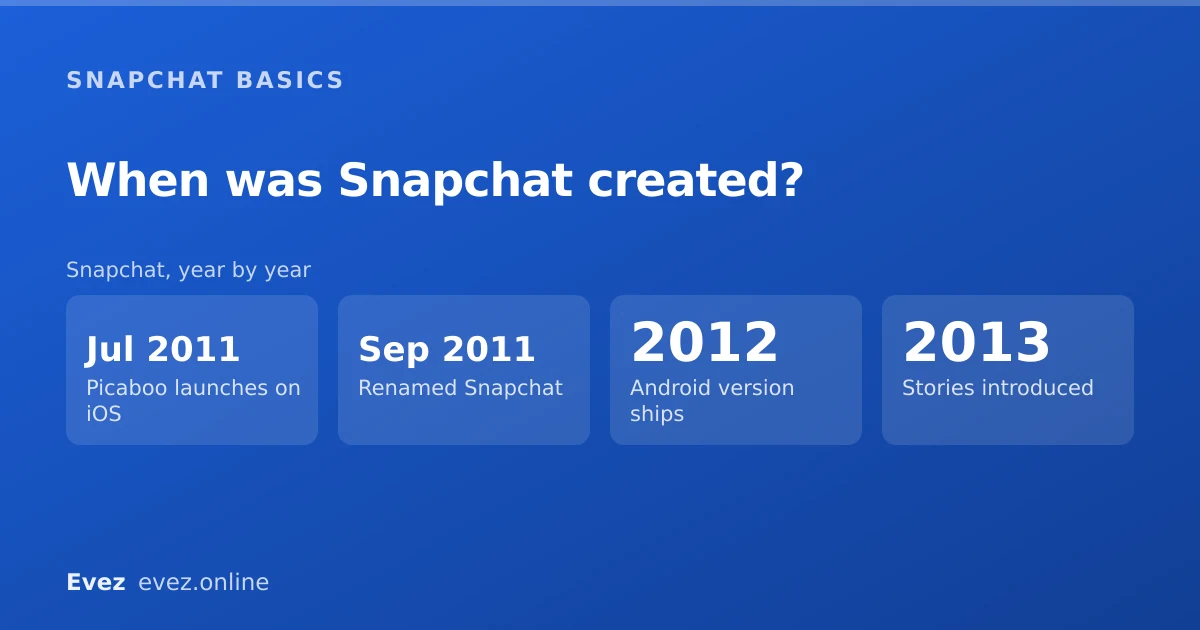
July 2011, as Picaboo, built by Stanford students Evan Spiegel, Bobby Murphy and Reggie Brown. It became Snapchat that September after a trademark dispute, and Snap Inc. listed on the NYSE in 2017.
Key takeaways
- July 2011 as Picaboo; renamed Snapchat in September 2011.
- Founded by Evan Spiegel, Bobby Murphy and Reggie Brown at Stanford.
- Reggie Brown was pushed out and later settled a lawsuit over co-founder credit.
- Snap Inc. listed on the NYSE in March 2017 at $17 a share.
On this page
The founding
Most answers to this give you a year and stop there. The idea came out of a Stanford product design class: Reggie Brown suggested an app for photos that disappeared, Evan Spiegel thought it was a business, and Bobby Murphy built it. The first version shipped for iOS in July 2011 under the name Picaboo.
It was renamed Snapchat that September after another company using the Picaboo name objected. The Android version followed roughly a year later, in late 2012, which is a large part of why the app's early culture was so heavily iPhone-shaped.
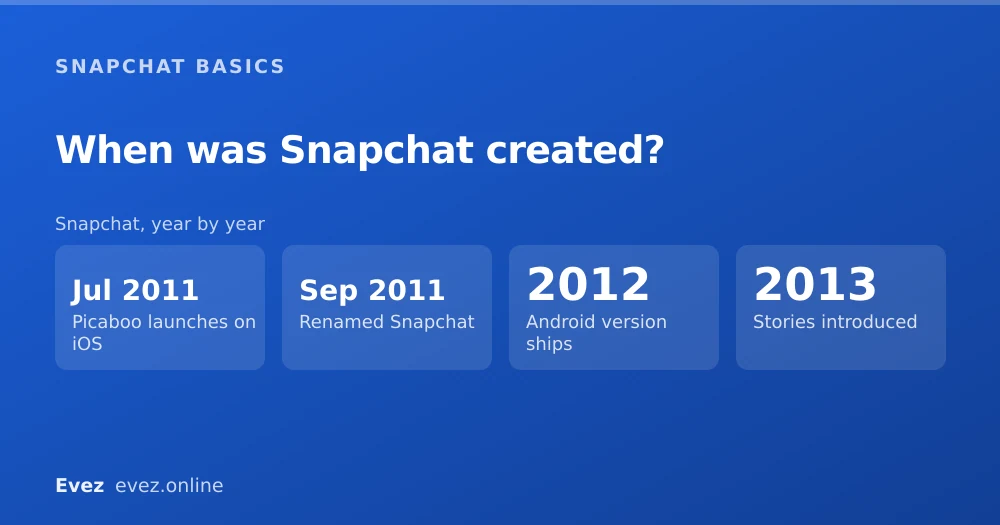
- Jul 2011Picaboo launches on iOSBuilt by Stanford students Spiegel, Murphy and Brown
- Sep 2011Renamed SnapchatAfter a trademark objection to Picaboo
- 2012Android version shipsRoughly a year behind iOS
- 2013Stories introduced24-hour posts — later copied industry-wide
- 2013Facebook's $3bn offer declinedReported acquisition approach, turned down
- 2014FTC settlementOver claims that messages disappeared forever
- 2014Snapcash launchesPeer-to-peer payments with Square; killed in 2018
- 2016Memories addedSaved snaps become a permanent archive
- 2016Renamed Snap Inc.Repositioned as a camera company
- Mar 2017IPO on the NYSEPriced at $17 a share
- 2020Spotlight launchesShort-form public video
- 2022Snapchat+ subscriptionFirst consumer subscription tier
- 2023My AI rolls outChatbot pinned to the chat list
- 2025–26Memories storage limitsFree allowance introduced with paid tiers above it
The third founder
Reggie Brown is the part of the story most short answers leave out. He was pushed out of the company in 2011, sued in 2013 claiming he had originated the disappearing-photo concept, and settled in 2014. Snap acknowledged his contribution as part of the settlement.
This matters for accuracy: pages that name two founders are describing the company as it operated, not as it began. Snap's own IPO prospectus discusses the litigation, which is the most reliable public account of it.
We have been subject to claims relating to the founding of our company.
Snap Inc., risk factors in its Form S-1 registration statement
Why Stories mattered
The 2013 addition of Stories — posts visible to all your friends for 24 hours — is arguably more consequential than anything else on the timeline. It was copied by Instagram in 2016, then by WhatsApp, Facebook, YouTube and LinkedIn.
It also created most of the questions people still have about the app, because a story has different visibility rules from a direct snap. Who can see it, who is notified about what, and where it goes when it expires are covered in the story viewer guide and viewing old stories.
The company today
| Founded | July 2011, as Picaboo |
|---|---|
| Renamed Snapchat | September 2011 |
| Parent company | Snap Inc. (renamed from Snapchat, Inc. in 2016) |
| Founders | Evan Spiegel, Bobby Murphy, Reggie Brown |
| Headquarters | Santa Monica, California |
| Listed | New York Stock Exchange, March 2017, ticker SNAP |
| First platform | iOS; Android followed about a year later |
What changed most recently
The change with the most practical effect on existing users is the most recent one: Memories moving from unlimited free storage to a free allowance with paid tiers above it. For anyone who has been saving to Memories since 2016, that turns a decade of accumulated photos into something with an ongoing condition attached.
What it means and how to export everything before deciding is covered in is Snapchat deleting Memories.
Frequently asked questions
When was Snapchat created?
It launched in July 2011 under the name Picaboo and was renamed Snapchat in September 2011 after a trademark objection.
Who created Snapchat?
Evan Spiegel, Bobby Murphy and Reggie Brown, while students at Stanford. Brown was pushed out in 2011 and settled a lawsuit over co-founder credit in 2014.
Why was Snapchat originally called Picaboo?
That was the founders' original name for the app at its July 2011 launch. Another company using the name objected, and it became Snapchat that September.
When did Snapchat go public?
Snap Inc. listed on the New York Stock Exchange in March 2017 under the ticker SNAP, priced at $17 a share.
Sources
Every source below was checked and returned a valid response at the time of the last review. Each note says which claim in this guide it supports.
- Snap Inc. Form S-1 registration statement (IPO prospectus) — U.S. Securities and Exchange Commission (EDGAR)Supports: The company's own account of its founding, the 2017 IPO, and the founder litigation.
- Snap Inc. annual reports on Form 10-K — U.S. Securities and Exchange Commission (EDGAR)Supports: Corporate structure and the current filing record for Snap Inc.
- In the Matter of Snapchat, Inc. (FTC File No. 132-3078) — U.S. Federal Trade CommissionSupports: The 2014 FTC settlement entry on the timeline.
Related guides

How to use Snapchat
The five-screen layout, sending your first snap, what the timers mean, and the settings worth changing on day one.
Snapchat basics · Updated

Is Snapchat deleting Memories?
Snapchat introduced a storage limit on Memories with paid tiers above it. What that means for existing archives, and how to export everything first.
Memories and storage · Updated
Is Snapchat encrypted?
Snaps are end-to-end encrypted. Text chats have not carried the same guarantee. Here is the precise boundary, and why the difference matters.
Privacy and location · Updated